
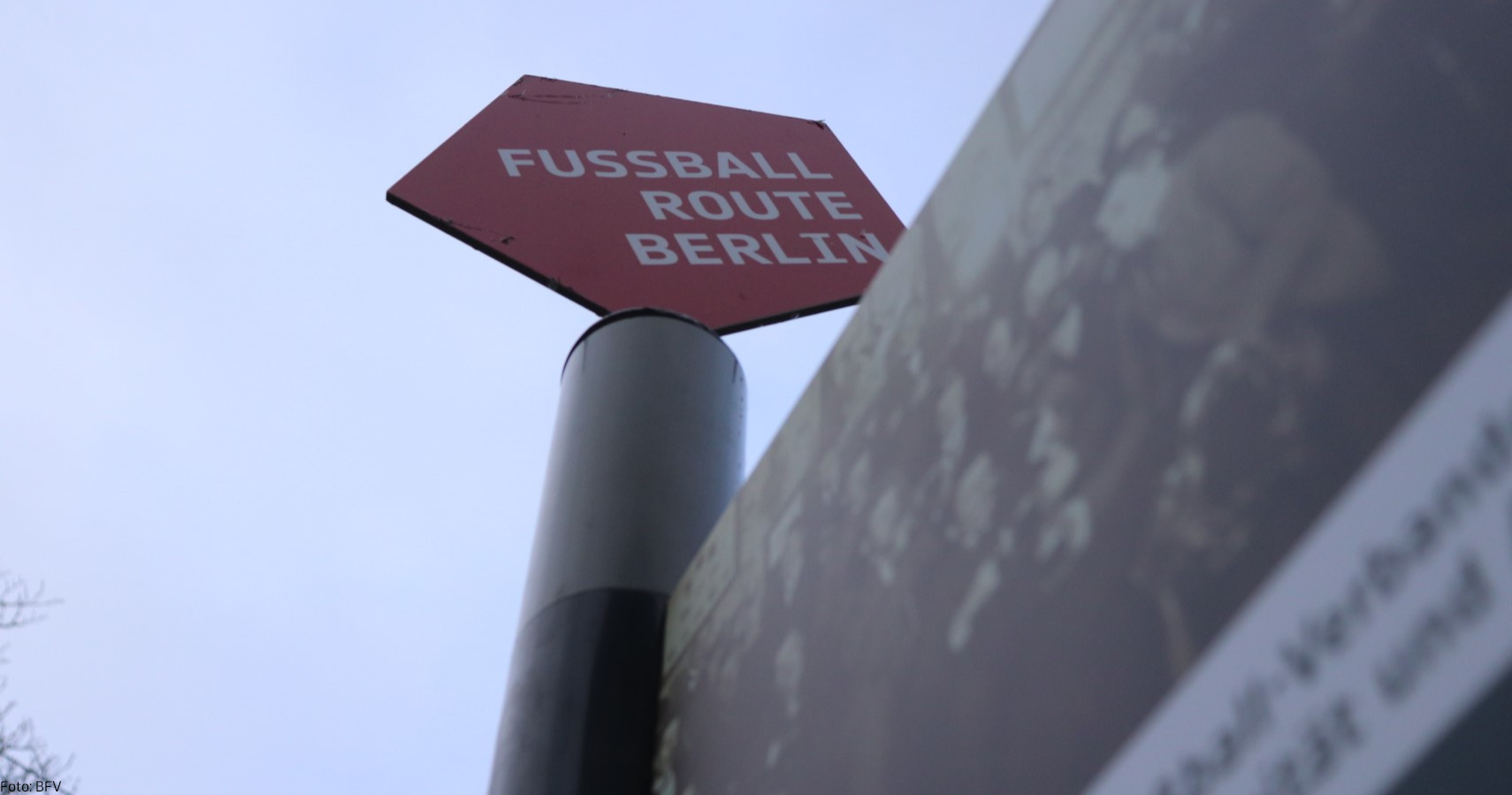
The "Sport:Kultur" association was founded in February 2012 on the initiative of the Berlin Football Association. The aim is to understand sport more strongly as culture. The association is concerned with movement and encounters in history and society and sees itself as a platform for a wide range of sporting activities in the cultural sector.

The purpose of the association is to research, communicate, discuss and publicly present the cultural and social significance and responsibility of sport - especially soccer - in the past, present and future. As its first significant project, the association has realized the FUSSBALL ROUTE BERLIN since October 2012. As part of the 125th anniversary of the BFV in 2022, Sport:Kultur e. V. was entrusted with the preparation of the association's history in the form of publications and an exhibition.

The FUSSBALL ROUTE BERLIN leads to 40 authentic locations in the city, makes the capital's unique soccer history tangible and provides information about sporting, cultural and urban historical contexts. It shows the great importance of soccer in Germany, which has undergone major changes since its beginnings in the 19th century, and illustrates the achievements of the athletes and clubs as well as the significant events of soccer in the city.

An important pillar in the early years was the soccer history working group initiated by the Sport:Kultur association. In this group, sports historians, club chroniclers and archivists met several times a year for an open exchange on sports history and cultural history topics.

To mark the anniversary of "25 years of soccer unity", Arete Verlag published a commemorative publication entitled "Football Unity in Berlin: 1990-2015" in 2015, which was presented at a festive matinee in the ballroom of the Berlin House of Representatives on the anniversary of reunification.

After the official conclusion of the FUSSBALL ROUTE BERLIN project in October 2017, there were repeated occasions and opportunities for the project to be recognized, used or further developed and to be presented to the public. For example, the content was transferred to other formats or platforms.

In September 2020, the FUSSBALL ROUTE BERLIN locations were incorporated into the "berlinHistory" app. In this way, the medium-term perspective and sustainable benefits of the project have been permanently secured, as content can be expanded or deepened at any time.

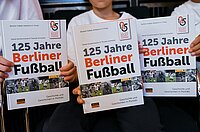
To coincide with the 125th anniversary celebrations, Arete Verlag published the book "125 Jahre Berliner Fußball. History and Stories in Portraits" was published by Arete Verlag . In addition, the traveling exhibition "125 Years of Berlin Football" was presented on the occasion of the ceremony in the Rotes Rathaus with a historical overview of the development of soccer in the city and the various periods against the backdrop of historical events in Berlin, which has since made guest appearances at various locations.

Following the matinee, the guests were presented with a calendar with historical stadium photos and a series of articles with texts on various historical topics from the eventful history of Berlin soccer was published on the BFV website in advance.

On the issue of its own past during the Nazi era, the BFV issued an official statement at the ceremony on September 11, 2022, in which it acknowledged its historical responsibility and reaffirmed its intention to critically assess the events, in particular the exclusion of Jewish members in 1933, and to have its role during the Nazi dictatorship reviewed in a historical study.

Work on the BFV study on the "History of Berlin soccer during the Nazi era" began in January, after an accompanying committee was appointed and an additional FUSSBALL ROUTE BERLIN stele on the history of the association with the declaration read out at the anniversary was erected in front of the BFV office.

In 2024, the year of the UEFA Euro in Germany, the book "Fußballheimat Berlin" was published. The travel guide series of the same name published by Arete-Verlag presents "100 places of remembrance". The Berlin volume, which was (co-)written by two club members, naturally also includes the FUSSBALL ROUTE BERLIN locations and identifies them as part of the project.
125 years BFV

On September 11, 1897, the Verband Deutscher Ballspielvereine (VDB) was founded as the first predecessor of today's Berlin Football Association. In 2022, the association, which today has 187,134 members in 371 clubs, celebrated its 125th anniversary. The BFV took this anniversary as an opportunity to look back at the history of soccer in Berlin and look ahead to the future.

Below you will find all the information about the history and the celebrations around September 11, 2022.

Ceremony in the Rotes Rathaus: Berlin celebrates 125 years of the BFV

On September 11, 2022, the Berlin Football Association turned 125 years old to the day. The BFV has been feverishly anticipating its anniversary since the spring, including with a series of historical articles, and has now celebrated this festive occasion with a ceremony in the Rotes Rathaus. Representatives from Berlin soccer clubs, politics and business as well as the Council of Elders and the association's employees were invited. In addition to an interesting stage program, the BFV also presented its illustrated information exhibition on the 125-year history of the association, which can be visited free of charge until the end of September in the Rotes Rathaus (Rathausstraße 15, 10178 Berlin) (Monday-Friday from 9:00 to 18:00) and then moves on to another location.

Bernd Neuendorf: "An important part of Berlin's city history"

The stage program for the ceremony opened with a speech by BFV President Bernd Schultz, which he introduced with a few words about the founding of the association: "September 11, 1897, seven club representatives founded the Association of German Ball Game Clubs in the "Dusteren Keller", a pub in Kreuzberg's Bergmannstraße. September 11, 2022, I warmly welcome you to the 125th birthday of the Berlin Football Association and I am very pleased that you have accepted our invitation". The association president looked back on the developments that Berlin soccer has undergone over the last 125 years and focused on the outstanding achievements that the BFV has made in the social sector, especially in recent history. Bernd Schultz also welcomed the guests of honor at the ceremony, which included DFB President Bernd Neuendorf and Ronny Zimmermann, DFB Vice President for Amateurs, as well as former BFV Managing Directors Dirk Brennecke and Michael Lameli.

Afterwards, Dennis Buchner, President of the House of Representatives, also addressed emotional words to the guests present: "What would Berlin, what would our city actually be without soccer? Without the footballers, young and old, who battle week after week in their classes? It's safe to say that our city would be a lot poorer without soccer," said the Berlin politician, introducing his welcome address on the role of the BFV for the city of Berlin, during which there was loud applause, especially when the outstanding importance of voluntary work was emphasized.

The main part of the stage program consisted of three rounds of talks, which were moderated by Florian Zschiedrich. First, BFV President Bernd Schultz, Andreas Geisel, Senator for Urban Development, Building and Housing, Thomas Härtel, President of the Berlin State Sports Association, and DFB President Bernd Neuendorf took their seats on the podium and spoke about the social significance of soccer, with the DFB President making the connection between remembering and learning for the present: "What is striking is that the BFV has always been an important part of Berlin's city history, and what is particularly important is that the Berlin Football Association is taking on the task of remembering. They try to pick up on certain pieces from the past, learn from them and thus counteract current negative developments in our society".

Remembrance and reappraisal

After a musical interlude by the band Savoy Satellites and a video clip on the faces and stories of Berlin soccer, presenter Florian Zschiedrich welcomed a few of these personalities to the hall. Refereeing legend Peter Gabor, former Viktoria Berlin president and oldest BFV member Lu Pfannenschmidt and former BFV presidents Uwe Hammer and Otto Höhne were present at the ceremony and were honored by the audience with a long round of applause for their commitment to Berlin soccer.

Afterwards, the guests listened with interest to the presentation by BFV historian Thomas Schneider from Sport:Kultur e.V., who, together with his colleague Daniel Küchenmeister, spent months researching the history of the association so that the results could be presented and published in detail as part of the anniversary celebrations. On this occasion, the new FUSSBALL ROUTE BERLIN stele was also unveiled, which is positioned in front of the BFV office (Humboldtstraße 8a, 14193 Berlin) and focuses on the role of the association during the Nazi era. BFV President Bernd Schultz also announced the commissioning of an independent academic study that will relentlessly examine Berlin soccer's connection to the National Socialist regime.

Looking to the future

The morning was rounded off with a look into the future of the BFV. A video clip on the association's social commitment was first presented before BFV Managing Director Kevin Langner, Christian Gaebler, Vice President Public Relations, Lisa Marie Großer, Member of the Executive Committee Young Generation/U27, and Malte Schruth, Member of the Executive Committee Innovation, Club and Association Development and Qualification, were invited on stage by the moderator. Together, they discussed the present and future of soccer in Berlin, with digitalization, new forms of play and social aspects being central topics of the discussion.

The talk marked the end of a diverse ceremony that allowed all those present to reminisce about exciting memories, addressed the positive and negative facets of Berlin's soccer history and provided an interesting outlook for the next 125 years of the Berlin Football Association.

BFV commissions study to come to terms with its Nazi past

The Berlin Football Association has been initiating campaigns and projects against discrimination, racism, right-wing extremism and anti-Semitism for many years and is committed to tolerance, fairness and equal opportunities in sport and society. These initiatives also arose from a critical examination of the club's own past, particularly the history of the Nazi dictatorship.

The preparations for the 125th anniversary of the BFV and the preparation of the accompanying commemorative publication and exhibition on the history of Berlin soccer have led to the realization among all those involved that current knowledge about the role of Berlin soccer and the actions of its officials during the Nazi era is inadequate. The BFV is taking this as an opportunity to critically reappraise its own past with an independent, scientific study and issued the following official statement at the ceremony on September 11, 2022:

"After the National Socialists came to power in 1933, Berlin soccer and its players, in particular the Berlin Ball Clubs Association (VBB), willingly submitted to the new rulers, allowed themselves to be brought into line and adapted their structures to the Nazi regime. In July 1933, the DFB and the VBB liquidated themselves. During the National Socialist dictatorship and tyranny between 1933 and 1945, dissidents such as former trade union activists, social democrats and communists were marginalized. Jewish citizens were excluded from soccer clubs and banned from participating in or attending cultural and sporting events. These measures were among the crimes that led to millions of murders and the Holocaust.

The Berlin Football Association, as the successor to the VBB, acknowledges that injustice was committed in Berlin soccer, in the clubs and in the association during the National Socialist era. It declares that it will critically assess the events, in particular the expulsion of Jewish members in 1933, and will have its role during the Nazi dictatorship investigated in a historical study. And above all, it wants to commemorate the victims of discrimination, persecution, violence and murder by the National Socialists in the future and remember the crimes so that nothing like this can ever happen again."

A corresponding decision has already been made by the Executive Committee to commission a scientific study. In autumn 2022, the BFV will bring together representatives from politics, academia and sport in a committee to define the principles of the study and select a suitable expert or institution to implement the project. The BFV aims to present the results of the study to the public in the run-up to UEFA EURO 2024 in Germany.


Anniversary videos

The program for the ceremony in the Rotes Rathaus was supplemented by moving images. Special thanks go to the protagonists in the films. The willingness of Berlin amateur soccer to participate in this project was overwhelming. Unfortunately, not all facets of 125 years of Berlin soccer history can be captured in just a few minutes of video. Many interesting personalities and stories from the history could not be highlighted in this framework due to this time limit, even if they also deserved it. However, the selected protagonists of the two films definitely provide a very nice insight into the special features of Berlin soccer.

Personalities from Berlin soccer look back (1/2)

The protagonists of the first film look back on various experiences and stories of Berlin soccer:

  • Don't let the club down
    Luise "Lu" Pfannenschmidt held various positions at BFC Viktoria 1889 after the end of the Second World War. Together with her husband Carl-Heinz, she shaped the history of the club. She was active as secretary, managing director and vice-president and took over the chairmanship of the club after her husband fell ill at the age of 73. Luise Pfannenschmidt will be 100 years old in 2023 - she looks back on Berlin's soccer past with joy.
  • VSG Altglienicke and reunification
    Bernhard Bieske talks about the turbulent times before and during reunification from the perspective of the East Berlin club VSG Altglienicke. On November 17, 1990, the East Berlin clubs joined the Berlin Football Association at the Hotel Intercontinental, thus merging the two previously separate Berlin soccer associations.
  • Amateur champion 1962: SC Tegel
    Volker Behnke and his team pulled off the big surprise at the Stadion am Zoo in Wuppertal in 1962. The underdogs won 1:0 against the heavy favorites "Tura Bonn." It was above all team spirit that enabled them to pull off this surprise, which Volker Behnke fondly remembers on behalf of his team to this day.
  • Reunification match 1990: Hertha - Union
    Olaf "Leo" Seier (Union captain), Dirk Greiser (Hertha captain) and Bodo Brandt-Cholle (referee) met up again at the scene of the match. They talk about the emotions and the sporting and social significance of the friendly match in the Olympic Stadium on January 27, 1990, after the Berlin Wall fell on November 9, 1989. Probably the most emotional derby in German (soccer) history.
  • Challenges of the Berlin Football Association
    Uwe Hammer was elected president of the association in 1982, having previously been head of the youth committee. During his term of office until 1990, many decisions were made that are still in place today. For example, the renaming to today's "Berlin Football Association", the establishment of Berlin as a permanent venue for the DFB Cup final and the call for "growing together" through friendly matches between West and East Berlin teams in 1989.

Stories, personalities, characters (2/2)

As part of the ceremony on September 11, 2022 in the Rotes Rathaus, the focus was also on the future and the development trends of amateur soccer. The protagonists in the second film give an insight into their work and view of the social responsibility of Berlin soccer in the present and future:

  • VfB zu Pankow (West) and BSG Einheit Pankow (East)
    As treasurer of the East Berlin club at the time, Peter Deutschmann accompanied the successful coming together of the clubs, previously separated by the Wall, to form VfB Einheit zu Pankow 1893. To this day, he has an eye for the social responsibility of (amateur) soccer.
  • Kiezspaziergang S.C. Berliner Amateure and Türkiyemspor Berlin
    Gerd Liesegang and Mehmet Matur lead a joint tour of their Kreuzberg neighborhood and provide insights into their neighboring clubs. Both are very familiar with the social responsibility of the BFV. Gerd Liesegang as former and Mehmet Matur as current vice president.
  • Promoting talent in Berlin
    Roland Benschneider works as an association sports coach at the BFV and deals with talented young footballers on a daily basis. He gives an insight into the special features of soccer in Berlin.
  • Girls' soccer in Berlin
    Jana Heide is the head of the BFV's Alle Kicken mit project. The main aim of this project is to offer girls and women low-threshold opportunities to participate in sport. This involves creating protected areas where girls can try out their skills.

Commemorative publication for the BFV anniversary

With the commemorative publication "125 Years of Berlin Football - History and Stories in Portraits", the Berlin Football Association wants to pay tribute to 125 personalities who have shaped soccer in Berlin and beyond. It presents the life stories and achievements of players, coaches and officials - the "movers and shakers" of the sport.

In addition to the contributions by the authors, the book contains texts by Jan Buschbom, Erik Eggers, Michael Jahn, Gerald Karpa, Juliane Röleke and Frank Schurmann, various greetings and an informative appendix. It is published by Arete Verlag and is available for 24 euros directly from the publisher or from retailers(to the online store) as well as via Amazon.

Further historical publications:

Soccer unity in Berlin: 1990-2015

Soccer in Berlin: Players - Clubs - Emotions

Emancipation and soccer

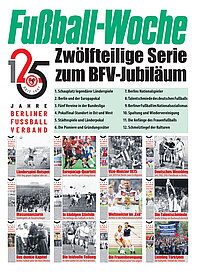
FuWo series: 125 years of the Berlin Football Association

To mark the 125th anniversary of the BFV, Berliner Fußball-Woche has published a twelve-part series of articles on the history of the association. This was published weekly as a special supplement in the print editions of the magazine and can be downloaded here:

FuWo series "125 years of the BFV"


Article series: The history of Berlin soccer

To mark the 125th anniversary of the BFV in 2022, Daniel Küchenmeister and Thomas Schneider from the Sport:Kultur e.V. association are looking back on the eventful history of Berlin soccer in a series of articles. Texts on a wide range of historical topics are published at regular intervals.

The following articles have been published:

Berlin in cup fever - a look back at the capital's cup history

The state cup before and during the Nazi era

No sooner had Berlin's soccer enthusiasts founded clubs and an association at the end of the 19th century than the regular championship matches that had begun just a few years earlier were no longer enough for them. In 1903, the "Neue Sportwoche" sponsored a prize and the cup fever that is still rampant today began. The Verband Berliner Ballspielvereine, which was founded in 1897 and was the forerunner of today's Berliner Fußball-Verband, played the first regular cup competition for three years from 1907, which was clearly dominated by the then BFC Viktoria 1889.

During the Weimar Republic, soccer developed into a mass sport. The Berlin Cup, which was played from 1920 and in which teams from Brandenburg also competed, was a crowd-puller from then on. However, this competition came to an end in 1934, as the soccer association that organized it was also de facto dissolved as part of the Nazi dictatorship's attempt to bring sport into line. The most successful club of that period was Hertha BSC, which probably had the best German club team at the beginning of the 1930s.

Soccer on both sides of the wall

In the post-war years, the cup tradition was continued from 1946. The trophy was now called the "Cup of the American Radio" - the RIAS Cup for short. With the onset of the Cold War, not only Berlin and the whole of Germany were divided, but also the sporting systems. Soccer in Berlin as a whole came to a standstill.

From 1950, the West Berlin teams of the VBB played the Karl-Heinz-Schulz-Pokal, which was renamed after Paul Rusch in 1970. The regular victories of SC Tasmania 1900 in the early 1960s should be highlighted here. In the German Football Association of the GDR, the East Berlin teams met in the FDGB district cup. Since 1957, company sports associations (BSG) such as Bergmann-Borsig, KWO Berlin and Lichtenberg 47 have entered their names on the list of winners.

German reunification in 1990, and in particular the unification of Berlin into a joint soccer association, brought the teams from the eastern and western parts of the city together again from 1991. The first winner of the all-Berlin competition caused a sensation. The amateurs of Hertha BSC reached the final of the subsequent DFB Cup competition in the Olympic Stadium in a complete surprise. Here, the "Hertha-Bubis" were only narrowly defeated by Bayer 04 Leverkusen 0:1.

The DFB Cup - Berlin as the big stage

The fact that the DFB Cup final is held in Berlin every year and has gradually become the "German Wembley" is by no means a matter of course but, like so much in sport, is due to the political circumstances of the 20th century.

As the division of Germany solidified during the Cold War and West Berlin's special status seemed to be permanent, politicians and sports officials were concerned that the city was in danger of falling further and further behind in terms of sport. In the mid-1980s, the efforts of BFV President Uwe Hammer, who had campaigned vehemently together with Senator for Education Hanna-Renate Laurien, were finally successful: the DFB Cup final was awarded to Berlin from 1985. Between 1985 and 2009, the women's DFB Cup final was also held in Berlin's Olympic Stadium immediately before the men's final.

Cup fever in the neighborhood

But it's not just the big stage of the DFB Cup that excites soccer fans. The cup competitions in Berlin's neighborhoods with traditional derbies are also very popular. The oldest of these is the "Exer Cup" in Pankow. Held since 1951, it commemorates one of the places that marks the beginning of soccer in the city - namely the former parade ground on Schönhauser Allee, where the Friedrich-Ludwig-Jahn-Sportpark is located today - and thus a time when cup fever began in Berlin.

"VAR Traditionsgemeinschaft des Fußballsports Berlin e.V."

Founded by the pioneers

On February 26, 1926, numerous gentlemen in their fifties gathered in the Kreuzberg pub "Weißer Mohr". It seemed that merchants, owners of local businesses and master craftsmen were meeting here for a sociable evening. But it was the pioneers of Berlin soccer who, in the years between 1880 and 1914, got the ball rolling and onto the pitch in the city and, in some cases, even in Germany. Emil Wernicke, who organized the games at Germania 1888, the oldest German soccer club, had invited them. Georg Leux had come, who founded BFC Frankfurt in 1885 as the first soccer club in the city. Georg Demmler, who was largely responsible for the initiative to found the DFB, was also present. At a time when soccer in Germany, and especially in the metropolis of Berlin, was becoming increasingly popular with the masses, these grassroots sportsmen created an association to preserve history and cohesion, to which the "VAR Traditionsgemeinschaft des Fußballsports Berlin e.V.", which is still active today, can be traced back.

Like all sports organizations, the association was banned by the Allies after the Second World War. Although the "old-timers" met again on October 12, 1946 in the NNW-Kasino, again at the instigation of Emil Wernicke, the VAR was not reconstituted until 1950. Its members came from all districts of the city, regardless of which side the Cold War and the double foundation of the state in 1949 had taken them. Only the construction of the Berlin Wall in August 1961 separated the sports comrades for three decades. Around a tenth of them lived in East Berlin at the time and were no longer able to actively participate in club life until 1989.

A unique community to this day

German reunification in 1990 was also a stroke of luck for the "Alte Rasensportler". Berlin soccer tradition could now be lived together again. However, the thirty-year division was not without consequences. As the general conditions of the sport and the personal experiences were different, today more sports comrades from the West find their way into the traditional community, which could only exist continuously in this part of the city.

Forms of remembrance and expectations of traditional soccer clubs change with the generations. What has been consistent since the beginning of the sport, however, is the need to reminisce, preserve achievements and socialize. The "VAR Traditionsgemeinschaft des Fußballsports Berlin e.V.", as an extraordinary member of the Berlin Football Association founded almost 125 years ago and the only association of its kind under the umbrella of the DFB, still successfully implements the idea of cohesion of the pioneers of Berlin soccer from 1926.

Women's soccer from the beginnings to today

First teams founded before the ban on women's football was lifted

When the Berlin Wall had already divided the city for eight years, the modern history of women's soccer began in both parts of the city. In 1969, the first teams were founded in West Berlin and girls' and women's sections were formed. Tennis Borussia, 1. FC Lübars, Wacker 04 and Schwarz-Weiß Spandau got the ball rolling. As the DFB only lifted its ban on women's soccer a year later, the women initially played illegally. But it wasn't just sports officials who were opposed to women's soccer. The district authorities, who were responsible for many sports facilities, also had to be tricked by occasionally registering training as a handball match.

The women of Tennis Borussia received particular public attention in the early years. They were coached by former professional player Horst Nußbaum, then popular as pop singer and music producer Jack White.

More decisive for the development of women's soccer, however, was the fact that the number of teams increased rapidly at the beginning of the 1970s and made regular match operations possible. The first official city championship in the west of divided Berlin was won by Schwarz-Weiß Spandau in 1972 and the first cup competition was won by BFC Meteor 06 in 1974.

Barbara "Charly" Streuffert from Tennis Borussia grew up to become an outstanding personality in women's soccer in the west of the city. She played her first game at the Mommsenstadion in November 1970. As an active player, she won the title of Berlin champion four times in the Verbandsliga. Steuffert, who worked as a clerk at the Reinickendorf Youth Welfare Office, was the first Berlin woman to obtain her B and A licenses and took on increasing responsibility until she was finally given the position of coach. She also became Berlin champion twice as coach of TeBe. In 1981 and 1983, the team made it to the final of the German championship, losing 4-0 and 6-0 to SSG 09 Bergisch Gladbach respectively. In 1990/91, Streuffert led the TeBe women into the then two-tier women's Bundesliga.

Parallel development in East Berlin

In East Berlin, the development of women's soccer largely took place at the same time. In April 1971, the Berliner Zeitung reported that the BSG EAB Lichtenberg 47 had "set up a women's soccer team ... which is still looking for playing partners". The GDR Football Association was generally hesitant and from September 1971 only allowed matches to be played as part of a popular sports round. In addition to the Lichterberg women, the top performers in East Berlin in the coming years were the teams from Motor Köpenick and Kabelwerk Oberspree, who dominated the championships.

In the 1980s, players such as Maja Bogs and Kathrin Nicklas stood out in East Berlin, striving for performance-oriented soccer. Nicklas was also called up for the first and only international match of a GDR women's team in May 1990.

After the fall of the Berlin Wall and German reunification, women's soccer in Berlin was finally able to grow together. The Berlin Football Association and the clubs were faced with an unprecedented situation, which they successfully mastered. Thanks to the dedicated work of the active players, the sporting and organizational development of women's and girls' soccer in Berlin was successful in the years from 1990 onwards. A look back at the beginnings some five decades ago shows, however, that neither organized women's soccer nor an all-Berlin game were a matter of course at all times.

Berlin soccer and reunification

The path to soccer unity in Berlin

Just one week after that historic night in November 1989, when the wall that had separated East and West for 28 years came down in Berlin, the then president of the Berlin Football Association, Uwe Hammer, and his East Berlin counterpart, the chairman of the district soccer committee, Uwe Piontek, held their first meeting.

As early as the end of November, Hammer called on all West Berlin clubs to play friendly matches with East Berlin and GDR clubs, thus ensuring that athletes from both parts of the city met, which contributed significantly to the growing together of East and West.

From the very beginning, it was clear to those involved that only a common path could be taken in Berlin. Even at a time when the reunification of the two German states was by no means certain at a national level, it was clear to soccer in Berlin that after 28 years of division and 40 years of playing separately, the two halves of the city belonged together again.

Integration process until November 1990

It soon became clear that the East Berlin district soccer committee would have to reorganize itself, and so the Berlin Football Association (FVB) was founded on 22 June 1990. This only existed for a short period of time and basically had the sole purpose of acting as a counterpart to the West Berlin Football Association in the planned merger.

Until then, many different tasks had to be accomplished. Initially, the FVB office was still located at Hausvogteiplatz, but then moved to the Werner-Seelenbinder-Halle building in the second half of July. The West Berlin Football Association helped out with furniture and office equipment and also provided advice and support in other ways.

Ultimately, the aim was to adapt the structures of East Berlin soccer and make the clubs fit for integration into the existing BFV match operations. Together, the diverse, often administrative tasks and legal issues - in club law, tax law and much more - were dealt with. The office was operated for this purpose until mid-1991.

On November 17, 1990 - before the unification of the soccer associations at a national level, which took place on November 20, 1990 in Leipzig - the time had come: the FVB decided to dissolve and the East Berlin clubs unanimously joined the Berlin Football Association at the extraordinary general meeting at the Hotel Intercontinental.

A memorable match

Just a few weeks before soccer unity was established in Berlin, a memorable match took place on October 21, 1990 at the Hans Zoschke Stadium in Lichtenberg: The amateur selection teams of the Berlin Football Association (East) and the Berlin Football Association (West) met in the DFB national cup, which was still being played at the time.

The East Berlin FVB, which had only existed for a few months and had been founded specifically for the purpose of being united with the West Berlin association, and the BFV fought a sporting duel for the first and, for all time, last time. Away from the pitch, they had long been on friendly terms.

Integration as a task

Commitment to fair play and tolerance has grown historically

The Berlin Football Association has been dealing with the issue of its social responsibility and its own social commitment for decades. It sees integration as an important task and is committed to fair play and tolerance with a wide range of campaigns and measures.

In the 1980s, violence in stadiums and on the fringes of soccer grew considerably in both parts of Germany. In the course of German reunification, this phenomenon intensified, particularly in the eastern part of Berlin and in the new federal states. Added to this were social problems that arose from the unification process in many areas of everyday life.

The BFV reacted to these developments. In the early 1990s, the then president Otto Höhne stated that "at grassroots level ... the problems of violence, xenophobia, youth crime and social hardship are part of everyday life in our clubs". On the same occasion, he spoke programmatically about the fact that human dignity is inviolable for the association. In the years that followed, initiatives were developed on which the association based its current self-image and work.

Foundation of the AG Fairplay in the 1990s

In the mid-1990s, various initiatives against violence on and around soccer pitches emerged in clubs from all parts of the city, which the BFV took up and bundled in the AG Fairplay, led by long-time vice-president Gerd Liesegang. The active rejection of violence, discrimination, racism and anti-Semitism now became a touchstone in the clubs and at the same time a unifying factor, regardless of origin and cultural identity.

The BFV brings together in its ranks many, especially young athletes with a migrant background, for whom soccer is of particular importance, as they still too often experience social or cultural rejection in other areas of society. The association has firmly anchored the topics of migration and integration in its statutes. In 2004, Mehmet Matur from Türkiyemspor Berlin was elected as a member of the executive committee and appointed head of the integration working group. This working group carried out and initiated a wide range of activities.

In 2008, the association organized the first "BFV Prevention Day", a mixture of sport, activities and entertainment. The meeting gave the clubs the opportunity to make contacts and find out about aspects of violence prevention.

FUSSBALL GRENZENLOS - support for refugees

When the number of refugees from war zones in Germany skyrocketed in 2015, the BFV took a clear stance and supported integration in a variety of ways. The welcome project FUSSBALL GRENZENLOS, which has been successfully promoting exchanges between clubs, social projects and refugee accommodation since 2016, deserves special mention.

In spring 2022, the Berlin soccer family was once again confronted with the arrival of many refugees in the city. Without hesitation, the BFV called on soccer clubs to accept refugees from Ukraine and other countries into their training programs(more information). It promoted this campaign in the knowledge that club sport offers people an excellent space for integration and makes a major contribution to stabilizing the social environment.

With this and many other activities, the BFV made a social contribution that went far beyond soccer and had a positive influence on tolerant coexistence in the city. Of course, sport cannot solve individual issues, let alone all socially relevant issues, and certainly not on its own. However, it is of crucial importance that the BFV has consistently expanded its role over the last three decades and, in addition to its main work - sport itself - has increasingly taken on social and cultural tasks and made an important contribution in the area of integration.

Important Berlin referees

Berlin referee referees first home match for a German national team

The lineage of Berlin referees who have become famous far beyond the city's borders and have had a formative influence on soccer is long.

The first international referee that Berlin produced was Paul Neumann from BFC Viktoria 1889, who refereed the first home match of a German national team, which took place on April 20, 1908 against England. The fact that a player from the home team was used as referee was a vote of confidence from the visitors from the motherland of soccer.

Alongside Carl Koppehel, who launched the "Berliner Schiedsrichter-Zeitung" on November 1, 1918 as the first German refereeing organ, Alfred Birlem in particular achieved even greater international renown after the First World War. Between 1927 and 1939, he refereed a total of 21 international matches and took part in the 1934 FIFA World Cup in Italy and the 1938 FIFA World Cup in France. Birlem also refereed the 1931/32 and 1932/33 German Football Championship finals and the first German Cup final two years later. He also refereed the bronze medal match between Norway and Poland at the soccer tournament of the 1936 Summer Olympics in Berlin.

In the 1950s, 1960s and 1970s, Werner Treichel and Ewald Regely were the outstanding men in black. Treichel was one of the most renowned referees in Germany in the 1950s and 1960s and headed the referee committee at the German Football Association from 1973 to 1978, making him the supreme head of all referees in Germany. Ewald Regely, who died at an early age and after whom the traditional tournament of Berlin referees is named, was also on his way to higher tasks.

Wolfgang Riedel - figurehead of East Berlin refereeing

On the East Berlin side, it was Wolfgang Riedel who made a career as an impartial referee from 1952 to 1978 and reached the highest levels of national and international soccer. He officiated 242 matches in the GDR's top division and 52 matches in the FDGB Cup, with the cup finals in 1965 and 1973 being highlights of his career. Riedel also officiated as a FIFA referee and refereed on the European and world stage of soccer between 1968 and 1978, including 11 senior international matches.

Peter Gabor became best known beyond Berlin in the 1970s and 1980s. Between 1969 and 1988, he made a total of 158 appearances in the Bundesliga. The sporting highlight of his career was the 1987 DFB Cup final in his home stadium, the Olympiastadion in Berlin. He also made a total of 26 DFB Cup appearances and 71 games in the 2nd division. In 1989, Gabor became chairman of the referees' committee of the BFV and, barely in office, had to master the historic task of merging the two Berlin referee organizations. In addition to his work as a referee observer up to Bundesliga level, he wrote the rules section of the DFB's referee newspaper until May 2008, making him a household name among young referees.

Lutz Michael Fröhlich began his career as a DFB referee in 1985 and refereed the DFB Cup final in 2003. He was active in the Bundesliga from 1991 and also as a FIFA referee from 1994 to 2002. When the betting scandal rocked German soccer in 2005, just a year and a half before the World Cup in his own country, it was Fröhlich who, together with his Berlin referee colleagues Manuel Gräfe and Felix Zwayer, reported discrepancies in various second division and cup matches to the DFB. After the end of his active career, he worked on a voluntary basis in the field of referee training and development. From 2008 to 2016, Fröhlich was employed as the full-time head of the DFB's refereeing department, and since 2016 he has headed the DFB's referee committee.

Throughout his career, referees from Berlin have rendered outstanding services to Berlin soccer and refereeing in Germany through their commitment and acceptance of responsibility.

International matches in Berlin

International matches before the founding of the German Football Association

The soccer city of Berlin has always been the venue for international matches and major international tournaments, which have attracted a great deal of attention in sport and far beyond.

It all began in 1899 with the so-called Urländerspiele, the first, still unofficial international matches against an English selection team, which took place on November 23 and 24, 1899 at the Athletik-Sportplatz on Kurfürstendamm. It was remarkable that the German Football Association had not even been founded at this time and Walther Bensemann, who had organized the matches almost single-handedly, had to overcome numerous obstacles - only in Berlin did he find the necessary encouragement and support for his ideas among the players and officials of the Association of Berlin Ball Game Clubs.

It was not until more than eight years later that the first official match of a German national team was played, also in Berlin - or more precisely in Mariendorf, which at that time was not yet part of the growing metropolis. The venue for the match against England on April 20, 1908 was the then BFC Viktoria 1889 pitch in Eisenacher Straße. The referee was Paul Neumann, a player from the home team who would go on to hold numerous positions in Berlin soccer in the following years.

A total of 46 matches for the men's national team in Berlin

The match marked the beginning of a long series of international matches that took place in Berlin. The men's national team has played a total of 46 times in the city over the past 125 years. The major tournaments were always a highlight.

At the 1974 World Cup in Germany, the DFB team played a preliminary round match against Chile in Berlin's Olympic Stadium on June 14. As is well known, the West German team was in the same group as the GDR team, but the historic clash between the two took place in Hamburg. Instead, the East German players were accommodated in West Berlin during the tournament and stayed in the Berlin Football Association's house on Kleiner Wannsee, which naturally attracted a lot of media attention.

When the European Championship tournament was awarded to Germany in 1988, the organizers wanted to avoid a similar constellation and did not consider Berlin as a venue for the tournament, which caused great outrage in the city. As a kind of substitute, the DFB organized a four-country tournament in which the hosts Argentina, Sweden and the Soviet Union took part and which was played in the Olympic Stadium from March 31 to April 2, 1988.

"Summer fairytale 2006" and the 2011 Women's World Cup as the most recent highlights

The undoubtedly biggest highlight in international soccer that took place in Berlin was the "summer fairytale", i.e. the 2006 World Cup in Germany, in which a total of six matches were played in the city. The accommodation of the German World Cup team in the Schlosshotel Grunewald and the team training sessions in the Mommsenstadion and in the amateur stadium on the Olympic grounds alone made the city feel like a special host. In addition, a diverse cultural program enriched the idea of soccer as a social factor.

The events culminated emotionally and in sporting terms in the quarter-final match against Argentina, when Germany goalkeeper Jens Lehmann made two saves in the penalty shoot-out and a piece of paper on which DFB goalkeeping coach Andreas Köpke had noted the preferences of the opposing shooters became a cult object.

But the history of major international tournaments in the city did not end there: just five years later, the next World Cup took place in Germany and in Berlin, namely the 2011 Women's World Cup. Under the motto "20elf at its best!", the tournament was opened with a big celebration in Berlin's Olympic Stadium on June 26, 2011.

When the UEFA EURO 2024 comes to Germany in less than two years' time and Berlin once again hosts six matches, including the final, the city and the Berlin soccer family will - that much is certain - be at their best.

International matches of Berlin selection teams

Premiere in Vienna in 1899

In the history of the Berlin Football Association, matches between selected teams played a prominent role until the 1960s. Matches against teams from other European countries in particular attracted public attention beyond the soccer family and drew crowds to the stadiums. Popular opponents included teams from Prague, Vienna, Paris, Basel, Copenhagen and Budapest. For the active players, being called up to the city selection was a great honor and it was no coincidence that these footballers were referred to as "representative players" for decades.

Just two years after the Verband Deutscher Ballspielvereine was founded, the officials dared to hold their first international matches with selection teams from other cities. The premiere on October 29, 1899 in Vienna was won 2:0 by the Berlin team.

The trip to English clubs in January 1901 was a highlight in the life of the still young association. All soccer enthusiasts in Berlin were aware at the time that they had to learn from the British if they wanted to promote the sport of soccer in Germany. The challenges in the run-up to such a trip were enormous for the soccer pioneers, as they had to raise the funds, organize the trip and recruit enough players for the matches.

England trip in 1901: match practice at the highest level

14 players and some officials set off on New Year's Day 1901 and played their first of five matches in Southampton on January 3. The team led by Paul Eichelmann (BFC Germania 1888) and Walter Jestram (Britannia 1892) arrived in the port city immediately after the crossing! The fact that all the scheduled matches were lost to the Berliners with a goal difference of 12:34 came as no surprise to the players or observers. The footballers from the German capital were not the least bit saddened by the defeats, but rather saw the benefits in the encounters with athletes from the other country and in playing at the highest level.

After the Second World War and the division of the Berlin Football Association into the West Berlin VBB and the East Berlin District Committee of the GDR Football Association, sporting encounters with foreign select teams often took on a political accent. The GDR in particular attached great importance to exploiting the matches for propaganda purposes. When the East Berlin team played against the Moscow team in front of 50,000 spectators in the Walter-Ulbricht Stadium on October 7, 1956, the SED newspaper celebrated the event as a "great gift" from the Soviet Union "for the seventh anniversary of the republic". However, the East Berlin players, such as the two-time goalscorer Günther Wirth from Vorwärts Berlin, were more interested in the sporting side and were reluctant to leave the pitch as losers with a 2:6 scoreline.

VBB team's trip to the USA: 15,000 spectators

The VBB used its contacts in another direction and organized a trip to the USA in May 1959, which had a long-lasting effect on players and officials. The Berlin City eleven won all six games and even defeated the US national team 3:1 in front of 15,000 spectators. Among the VBB's American players was Helmut Faeder, who was in the starting line-up for Hertha BSC on the first Bundesliga matchday in August 1963.

The changes in soccer from the mid-1960s onwards - such as increasing professionalization and the growing importance of electronic media, especially television - led to a loss of appeal for city matches. From then on, the character of the international matches changed and they increasingly served the development of amateur soccer and friendly sporting exchanges.

The benefits of sports facilities for Berlin

The establishment of sport in Germany

After the First World War, sport in Germany experienced an enormous upswing and established itself in society. Boxing, athletics, motor sports and cycling thrilled the public, but soccer in particular became a mass phenomenon in the Weimar Republic. In less than two decades, new types and dimensions of sports facilities were built in the country's major cities. In Berlin, the AVUS (1921), the Poststadion (1929), the indoor swimming pool in Gartenstraße (1930), the Deutschlandhalle (1935) and the Olympic Stadium (1936) were inaugurated, some of which are still of central importance for the city's recreational and top-class sport to this day.

The increasing mass character of soccer during this period was reflected in the growing number of active club members and clubs. However, the phenomenon became clearer to contemporaries through the masses of spectators watching matches on the pitch. The challenges for sports officials and architects when building new stadiums arose primarily from the need to meet the growing interest of spectators and to create sufficiently large arenas.

The VBB and its clubs recognized the new situation of their sport and campaigned for stadium construction in Berlin in the interests of soccer, taking action themselves. On the one hand, they wanted to spread soccer and, on the other, the spectator appeal guaranteed income. It was clear to those involved at the time that a stable financial basis was the main way to secure the future of the sport. Accordingly, the clubs also faced up to the increased popularity and created their own sports facilities on an unprecedented scale.

Important sports facilities were built

In 1923, BFC Hertha 1892 merged with the financially strong Berliner Sport-Club, which owned the pitch on the south side of Behmstraße in Wedding, and henceforth bore the name Hertha BSC. Immediately after the merger, construction began on the club's own stadium, which was popularly known as the "Plumpe" and developed into one of the most important soccer stadiums in Berlin for the next 40 years.

From 1924, BFC Preussen built a sports facility on the east side of Tempelhofer Damm, which offered space for up to 40,000 spectators, but soon proved to be oversized, as the club was no longer able to build on its great successes before 1918 and a few years later there were several large pitches in Berlin. In 1936, the stadium had to make way for the construction of the new airport building.

The Post Stadium was built between 1926 and 1929 on behalf of the Reichspostverwaltung. On the site of a former parade ground in Moabit, an extensive complex with a competition stadium, soccer pitches, tennis courts, a swimming pool and a rowing hall was built. It replaced the German Stadium in Grunewald in terms of its importance for the city and became the venue for numerous national and international soccer matches. The Poststadion was one of the first multifunctional arenas in Germany and became the model for numerous sports facilities.

The architect of the Poststadion was Georg Demmler, himself a versatile sportsman, soccer pioneer from the very beginning, club official and initiator of the founding of the DFB. After his active career as a footballer and track and field athlete, he turned to the construction of sports facilities. His work set national and international standards.

The Berlin clubs made full use of municipal and state funding opportunities such as building grants, tax relief and employment promotion measures in their construction projects. Political leaders and administrations also recognized the benefits of sports facilities for urban development and the population of Berlin.

An important phase of sports facility construction in Berlin ended with the construction of the Olympic Stadium, the planning of which began in 1931 after Berlin was awarded the Summer Olympics. The stadium, which was inaugurated on August 1, 1936 during the Nazi dictatorship, is still of extraordinary importance for the city today. In the present day, it plays a prominent role in soccer both nationally and internationally, be it as a venue for the Bundesliga club Hertha BSC or as the site of the annual DFB Cup final. In the future, soccer fans from all over the world will once again turn their attention to the Olympic Stadium when it hosts the final of the 2024 European Championships.

Equal participation in sport

Inclusion on the big stage

In May 2010, a memorable soccer match took place in Berlin against a remarkable backdrop. The German and Turkish national teams met, and the venue was not one of the many soccer stadiums in the city, but the meadow in front of the Reichstag building. It was a game of blind soccer, for which a small arena was specially built at this historic site.

In blind soccer, five players on both sides compete against each other, each of whom is blind or severely visually impaired. The ball is equipped with rattles inside, which allows the players to locate its position. The team's own guides, who are positioned behind the opponent's goal, and the coaches on the boards direct their players by shouting. They orient themselves to each other and warn each other with the exclamation "Voy!", which comes from the Spanish and means "I'm coming!". It is remarkable how quickly the game is played and how confidently the players handle the ball. When you realize that they can't see, it's astonishing to see the commitment - not to say daring - with which a game of blind soccer is played. This special type of game has existed in Germany since 2006, and the German Blind Football League, founded by the German Disabled Sports Association, the German Association for the Blind and Visually Impaired and the Sepp Herberger Foundation, started its first season in March 2008.

The fact that this venue was chosen for the one-off international match of the national blind soccer team and that the match was held in the immediate vicinity of the German Bundestag was of course symbolic. It was intended to express the fact that the equal participation of all in society is an ongoing task of politics, but also of civil society. Of course, this also applies to organized sport and therefore to the Berlin Football Association and its clubs.

It is important to create opportunities, provide resources and raise public awareness. High-profile events such as the aforementioned match in May 2010 make a valuable contribution to this. But prejudices must also be broken down in everyday life, mutual understanding must be created and a willingness to embrace diversity must be established. The Berlin Football Association is also working on this by encouraging its member clubs to establish inclusive structures and offers.

Soccer for people with intellectual disabilities

Another example of how people with various disabilities can actively participate in soccer is the German Football Championship of Workshops for Disabled People (WfbM), which is organized by the BAG WfbM and the Sepp Herberger Foundation and has been held since 2000. Around 340 players with intellectual or mental disabilities from the 700 or so workshops in Germany compete here to determine the best German WfbM team each year.

Below this level, the DFB regional associations and the LAG WfbM offer various opportunities for workshop teams to play. The focus here is not just on competition, but also on the footballers experiencing values such as fair play, tolerance and cohesion in a fun way, as well as having the opportunity to receive recognition for their sporting achievements, to be recognized beyond their disability and to feel part of society.

Present and future

In order to promote inclusion in soccer and to support the clubs in creating appropriate offers, the Berlin Football Association has created the position of an inclusion officer. The BFV is a member of the Sport & Inclusion Network and is committed to an inclusive Berlin sports landscape. It promotes and provides information about different types of soccer that enable people with different disabilities to play, such as wheelchair, walking frame or amputee soccer.

The next milestone on the road to greater social participation for people with disabilities is the Special Olympics World Games, i.e. the World Games for people with intellectual disabilities, which will be held in Berlin in 2023 and will also include a soccer tournament. This is another opportunity for the city and the Berlin soccer family to show that they are good hosts and are serious about implementing an inclusive society.

Three decades of the Berlin League

East and West united

The start of the Berlin League as the BFV's highest division was almost three decades ago to the day. The inaugural season was played in 1992/93 and its beginning remains an outstanding event in the long history of the development of the game in Berlin.

After the fall of the Berlin Wall in the course of the Peaceful Revolution of 1989/90, the question of merging the two Berlin soccer associations and a joint match operation soon arose. At the historic association meeting on 17 November 1990, at which the clubs from the east of the city joined the BFV and the soccer unity in Berlin was organizationally completed, this debate took center stage. After a long debate, the assembly decided, against the votes of many clubs from the eastern part, to assign the teams in the amateur Oberliga (West) to the new Oberliga of the NOFV from 1991/92 and to downgrade the Bezirksliga (East) as the second tier of the Landesliga. It was not until 1992/93 that an all-Berlin Verbandsliga was established as the BFV's highest division.

In 1990/91, the Landesliga was still played separately in East and West, only to determine its champion one year later for the first time since 1950 in an all-Berlin league. In decisive matches, 1. FC Lübars prevailed, securing the 1991/92 championship and promotion to the NOFV's Oberliga.

The Verbandsliga is created

Immediately after German reunification, many soccer enthusiasts called for a single league as Berlin's highest division, which became a reality in the 1992/93 season. Sixteen teams competed, five of which had previously qualified in each of the Landesliga seasons and a further six of which had been relegated from the Oberliga. This composition demonstrated the poor performance of Berlin soccer in those years. Champion of the season was Frohnauer SC, who finished just ahead of 1. FC Wilmersdorf, who were level on points.

The Berlin Verbandsliga - known as the Berlin-Liga from 2008 - was downgraded from the fifth to the sixth division following the DFB's reform of the divisions and the introduction of the 3rd division under the umbrella of the association. However, this formal classification said nothing about the performance of the teams, which had improved compared to the 1990s.

In the last three decades of the Berlin League, a number of amateurs have stood out with their performances and commitment. Michael Fuß, who played for several Berlin clubs, is a good example. In the 1999/2000 season, the striker almost single-handedly shot Türkiyemspor to the Berlin championship and set a record for eternity with 66 goals in 34 games.

Today, the Berlin League offers a high level of amateur soccer. It is no coincidence that twelve Berlin teams are currently represented in the NOFV-Oberliga Nord and the Regionalliga Nordost. Eight of them have become Berlin champions in the last decade alone and some of them have been extremely successful in establishing themselves in the higher divisions.

The BFV as a player in Berlin's urban society

Commitment to the sport of soccer

Unfortunately, the statutes of the Verband Deutscher Ballspielvereine, as the Berlin Football Association was called when it was founded in 1897, have not survived. It is therefore also impossible to reconstruct what was originally defined as the purpose of the association. Only a short passage is quoted in the association's commemorative publication on its 25th anniversary, which proves that the founders were concerned with far more than just the organization of a regulated game. In addition, the association's declared aim was "to introduce and spread the game of soccer and cricket in the better circles". In other words, the aim was to achieve social recognition for the sport.

Accordingly, it was part of the young footballers' self-image and pronounced self-confidence that they saw themselves as social actors at an early stage, wanted to play an active role in shaping their living conditions and campaigned for this at a political and institutional level. As the magazine "Mitteldeutscher Sport" wrote in 1913, it was clear to them that sport had now become an "equal cultural factor (...) alongside art and science (...)".

They actively sought proximity to the authorities, state agencies and municipal bodies in order to promote the interests of their members and improve the general conditions. With success: when soccer became a mass phenomenon after the First World War, the municipal administration increasingly recognized the creation and maintenance of sports facilities available to the general public and sports clubs as a public task.

Soccer establishes itself

This was all the more true after the Second World War, when reconstruction had to be carried out in several respects. First of all, the stadiums and sports grounds, which had been largely destroyed and unplayable, had to be rebuilt. Furthermore, the game had to be organized again, first under the conditions of the Allied occupation, then in the divided city. West Berlin soccer suffered organizationally and athletically from the insularity, and the special challenges had to be constantly pointed out within the sport and to politicians, and the interests of soccer had to be promoted.

The Berlin Football Association sought and found proximity to politics, and sport was seen as a partner and important social player. Its protagonists were enterprising and did not shy away from direct contact with political decision-makers - on the contrary: this was the only way to keep Berlin soccer viable and independent over four decades with separate match operations in the divided city. When it mattered most, namely after the fall of the Berlin Wall, soccer made its own significant contribution to reunification and the growing together of East and West.

Today, the framework conditions have changed fundamentally. The world has become more diverse and more complicated, and the challenges posed by social changes, political crises and megatrends such as digitalization, demographic change and many more are enormous. And yet the Berlin Football Association continues to see itself as a partner of politics and an important player in urban society. And it will not tire of adapting to the circumstances and ensuring that the sport of soccer enjoys widespread popularity and recognition.

Youth soccer through the ages

BFC Germania establishes youth work in German soccer

In the Berlin Football Association, great attention is currently being paid to young players. The many children and young people who play our ball sport in the clubs have fun together in the community, develop individual skills and experience collective togetherness. These intentions were already followed by the founders of soccer in the 19th century.

BFC Germania 1888 already established youth work in German soccer when its member Georg Demmler organized a regular training group for boys under the age of 18 ten years after the club was founded. However, the origins of youth work - which correspond to our ideas today - only date back to the years after the First World War.

During the Weimar Republic, soccer developed into a mass sport and attracted not only more and more young men, but increasingly also children and teenagers. The clubs now set up youth sections and youth representatives became active in the association. Soccer tried to generate enthusiasm for its sport with advertising campaigns, because those responsible had realized that this was the way to secure the future.

After the National Socialists seized power and brought society, including sport, into line, the soccer clubs and associations subordinated themselves to the new rulers. In those years, sport was only possible for children and young people if they also belonged to the organizations of the Nazi regime. Young Jewish athletes were excluded. Pushed to the margins of society, they organized themselves into their own clubs, but had to play soccer in secret from 1938/39 onwards.

In the post-war years from 1945, sport for children and young people took on an important social function. In the heavily war-damaged city of Berlin, soccer was the first sport that could be played again. The sports groups and later the clubs offered young people social support. Sport gave many children and young people a sense of direction in life during years of hardship.

The contribution of youth football to society as a whole

The division of Germany in 1949 hit Berlin particularly hard. Following the division, two sports systems developed in the city in line with the opposing social systems. In East Berlin, children's and youth sports, including soccer, had to comply with the political guidelines. Young footballers in particular were caught between the extraordinary promotion of top-class sport in the sports clubs and at the children's and youth sports schools and the often inadequate conditions in grassroots sport, which was organized in company sports communities.

In West Berlin, the sports movement developed on democratic ground and allowed more scope for the development of young talent. Clubs such as Hertha BSC, Hertha 03 Zehlendorf, Reinickendorfer Füchse and Tennis Borussia became centers of youth development. However, many of the city's talents left West Berlin, which - surrounded by the Wall - suffered from dwindling economic power. Despite all the problems caused by the division on both sides of the Berlin Wall, the clubs did an excellent job of developing young talent, producing the likes of Thomas Häßler, Pierre Littbarski, Frank Rohde and Andreas Thom.

Since German reunification in 1990, children's and youth soccer has developed enormously and reached an unprecedented level in terms of both quantity and quality. The Berlin Football Association focused on high standards in the systematic training of coaches and trainers on the one hand and on the continuous development of young players on the other. Girls' soccer experienced a major upswing.

Soccer in the various youth age groups has always had an important function beyond sport, as girls and boys practice togetherness across social and cultural boundaries on and off the pitch. The many volunteer helpers and often young coaches play a particularly important role in this. They make a significant contribution to cohesion and the future of society.

Foundation and development stages of the BFV

This year, the Berlin Football Association looks back on 125 years of history. The fact that it is so old is indisputable, because since its foundation on September 11, 1897 as the Association of German Ball Clubs, its history has not been unbroken, but it has been clearly continuous. And yet this year, it can not only look back on the unique historical event 125 years ago, but has actually already been founded three times.

The foundation 125 years ago

The association was founded 125 years ago in the "Dustren Keller" in Bergmannstraße, the club pub of BFC Preussen from 1894. The representatives of seven Berlin clubs founded the Verband Deutscher Ballspielvereine (VDB) on September 11, 1897, which was later renamed the Verband Berliner Ballspielvereine and still exists today as the Berliner Fußball-Verband. The meeting took place in a convivial setting, just as the young footballers generally placed great value on camaraderie and respectful, friendly interaction with one another.

After numerous associations had competed with each other in the early days and the German Football and Cricket Association initially determined the development in the 1890s, the strict leadership of the VDB brought about a qualitative leap in the self-organization of soccer. The often still boisterous joy of the game was increasingly incorporated into structures, which ensured continuity and social acceptance for the sport.

During the Weimar Republic, sport, and soccer in particular, developed into a mass phenomenon, with steadily rising membership numbers in the clubs and a growing influx of spectators. Soccer lost its predominantly bourgeois character and increasingly became a proletarian game. In addition to the DFB competitions, the denominational clubs and, above all, the Arbeiter-Turn- und Sportbund (ATSB) established regular match operations, although the VBB maintained its supremacy.

Gleichschaltung during the Nazi era and refounding after 1945

In 1933, after the National Socialists came to power, the VBB willingly submitted to the new rulers, allowed itself to be brought into line with the system and adapted to the structures of the Nazi regime. The DFB was incorporated into the National Socialist German Reich Association for Physical Exercise as the "Football Department". On July 4, 1933, the VBB was unanimously liquidated at the association's congress in the presence of 111 clubs, and Berlin and Brandenburg were merged into "Gau 3" of the department.

After the Second World War, Germany's social development was determined by the four victorious Allied powers. After footballers were able to organize themselves in municipal sports associations in the immediate post-war years, numerous traditional clubs were re-admitted from 1949 onwards. On December 2, 1949, the Verband Berliner Ballspielvereine was reconstituted. The first president of the association was Paul Rusch, who held office until 1970.

Fall of the Berlin Wall and reunification

After the fall of the Berlin Wall in the fall of 1989, the players in East and West were presented with the unique opportunity to reunite soccer in both parts of the city. On 22 June 1990, the teams in East Berlin, which were organized in the district technical committee of the German Football Association of the GDR, founded the Berlin Football Association (FVB), which basically had the sole purpose of acting as a counterpart to the West Berlin Football Association (BFV) in the planned merger.

On November 17, 1990 - i.e. even before the unification of the soccer associations at federal level, which took place on November 20, 1990 in Leipzig - the FVB decided to dissolve and the East Berlin clubs unanimously joined the BFV at the extraordinary general meeting in the Hotel Intercontinental. A few weeks earlier, on October 21, 1990, the amateur selection teams of the FVB and the BFV met in the DFB International Cup at the Hans Zoschke Stadium.

Review and outlook

In the past three decades since reunification, the Berlin Football Association has had to overcome numerous challenges: From the growing together of East and West, to sporting highlights such as the 2006 World Cup or the annual DFB Cup finals, to unsightly side effects such as violence on or off the soccer pitch, racism and xenophobia, to the latest social tasks such as the integration of people with refugee experience or coping with the corona pandemic.

The Berlin soccer family has grown continuously since then. The association assumes social responsibility and has a firm place as a social player in the city. This should remain the case in the future.