

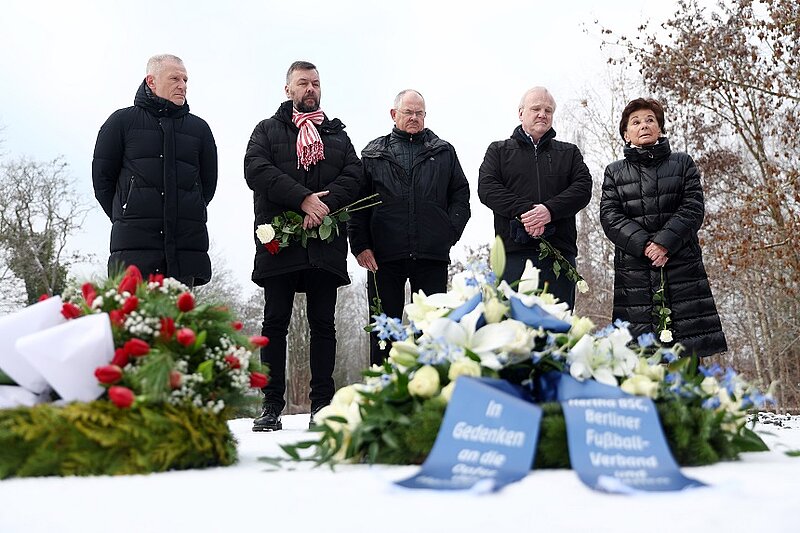
On January 27, 1945, the Auschwitz-Birkenau concentration and extermination camp was liberated. For many years, the soccer family has marked this date to commemorate the people who were persecuted, deported and murdered during the Nazi era.
/ Social responsibility
22nd Remembrance Day in German soccer: Sport is political
The myth of apolitical sport
Some people today claim that sport, and soccer in particular, has "nothing to do with politics". This narrative ignores how deeply involved the sporting structures of the time were in the Nazi system.
The National Socialist dictatorship systematically used sport for its political goals. Major events such as the Olympic Games in Germany became a propaganda stage on which the regime staged strength and supposed unity, while at the same time opponents were persecuted, arrested and silenced.
Soccer as a propaganda tool during the Nazi era
The Nazis' "Gleichschaltung" did not stop at the Berlin soccer landscape either. Dissenting opinions and lifestyles were to be suppressed or even eradicated: Jewish, church or workers' sports clubs were banned or forcibly brought into line, critical voices silenced. Many soccer clubs excluded Jewish members or urged them to leave themselves. In Berlin, the example of Tennis Borussia impressively demonstrates the systematic exclusion of Jewish life from the sport. At a general meeting of the club convened at short notice on April 11, 1933, it was decided that all board members of Jewish denomination would resign. At the same time, the majority of the membership declared their "withdrawal from the club" (see A pillar of the system? Berlin soccer under National Socialism).
It was not until later that clubs and associations began to critically examine their own role during the Nazi era. Last year, for example, the BFV published the study "A pillar of the system? Soccer in Berlin under National Socialism"last year, making it the first regional association to shed light on its role during the Nazi era in this form.
Today: Defending democracy
Anti-democratic groups still use soccer today to spread their misanthropic slogans. Stadiums and sports grounds are becoming places of confrontation where it is once again important to take a clear stance.
The "Never Again" initiative is calling for German soccer's Remembrance Day to be used as an opportunity to actively combat discrimination of all kinds and to commemorate the victims of the Nazi era.
Information on events surrounding the 22nd Remembrance Day can be found on the berlin-gegen-nazis.de website: Events on the Day of Remembrance of the Victims of National Socialism. We remember so that the past is never repeated again.
Kategorien: Social responsibility