
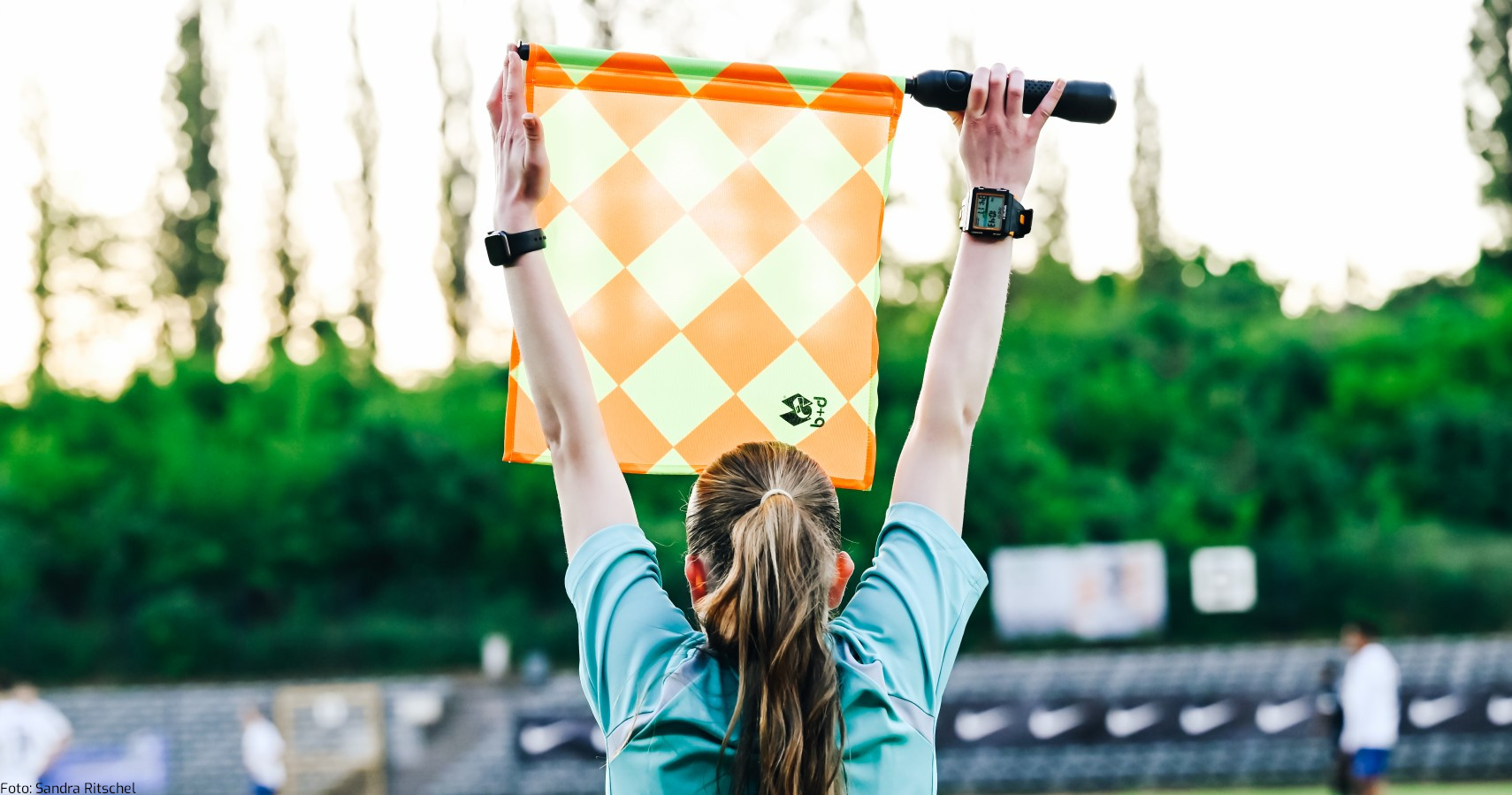
The SRDK deals with disciplinary measures in the Berlin refereeing system in the event of misconduct by referees, supports them in resolving disputes and advises the SRA on legal issues. Individual members support referees who have been victims of violence, discrimination or other criminal acts. During the winter break, the SRDK selects the national winners of the DFB's "Danke-SR" campaign from the nominations submitted by the teaching communities.

The following sections provide a detailed overview of our tasks. At the bottom of the page you will find some statistics.

Members

Jonas Tylewski

Vorsitzender

jonas.tylewski@spam.berlinerfv.de

Jonas is a fully qualified lawyer, works in the Foreign Service and has been Chairman of the SRDK since 2021. He has been a referee since 2007, officiates in the Berlin League and is a member of VfB Concordia Britz.

His idea for the SRDK: "In order to maintain the integrity of refereeing both externally and internally, a corrective is essential. The SRDK aims to meet this requirement by making prudent and fair decisions. The SRDK works for the referees, not against them."

Friedrich Hestermann

stellv. Vorsitzender

Friedrich is a fully qualified lawyer, works as a lawyer and has been Deputy Chairman of the SRDK since 2021. He has officiated as a referee since 2011, currently in the national league. He is a member of Polar Pinguin.

On his position on the SRDK, he says: "The SRDK is a useful institution for clarifying misconduct by referees and preventing it in the future. It is also suitable for resolving conflicts within the arbitration system, which is why I am happy to get involved."

Jörn Halfter

Mitglied

Jörn has been a referee and member of Hertha 03 Zehlendorf since 1989. He has held a number of positions in Berlin soccer, from player to coach. He has been a member of the SRDK since it was founded.

Katia Kobelt

Mitglied

katia.kobelt@spam.berlinerfv.org

Kati has been a referee since 2004 and officiated as an assistant in the women's Bundesliga. She is currently an observer and officiates for VSG Rahnsdorf. She has been a member of the SRDK since 2021.

Klaus Windmann

Mitglied

Klaus was a prison officer and has been involved in the SRDK since 2021. He has been a referee and member of Hertha BSC since 2005.

René Richter

Mitglied

René has been a referee since 1998 and has been a member of the SRDK since 2018. He is a member of Hertha BSC.

Why René is involved in the SRDK: "Due to my many years as a referee, I think it makes sense to be part of this unique and independent committee in the refereeing world. As a former referee and deputy head referee, I can contribute a wealth of experience."

Disciplinary measures against SR

The referee regulations define the main task of the SRDK as sanctioning misconduct by referees and putting them back on the right track. In Berlin, this is not the responsibility of the SRA, but of the independent SRDK, which is not bound by instructions.

Whenever referees behave in an unsportsmanlike or unfriendly manner or violate the referee regulations (SRO), the statutes or other BFV regulations, this can lead to a disciplinary measure in accordance with § 5 SRO (§ 2 no. 6 a. SRO). Which disciplinary measures can be imposed is regulated in § 5 no. 7 SRO: possible measures range from a mere reprimand to demotion to a lower league and suspensions of up to one year to removal from the list of referees.

The SRDK procedure at a glance

1 When does the SRDK take action?

Misconduct by SRs is only prosecuted upon application. This means that the SRDK does not act independently ("ex officio") when it learns of possible misconduct (§ 5 no. 3 SRO). The executive committee of the BFV, the referees' committee, the respective regional management and every "recognized referee" (see § 1 no. 1 a. SRO) are entitled to submit an application. The sports court can also refer cases to the SRDK (§ 5 no. 3 sentence 2 SRO).

2 How is a request submitted?

An application can be submitted informally by e-mail: sr-disziplinarkommission@berlinerfv.de. Each application must contain at least the following information

  • Applicant

  • Authorization to apply

  • Accused/defendant

  • As precise a description of the accusation/misconduct as possible, including the date

  • Naming of possible witnesses, if applicable

3. what happens after the application?

If the conduct described in the application can lead to a disciplinary measure after examination by the chairperson of the SRDK or his/her deputy, the SRDK will initiate proceedings and give the accused SR the opportunity to respond. The accused may invoke their right not to make a statement. The SRDK must be informed of this. The application is then usually heard orally.

4 How can I imagine an oral hearing?

The SRDK generally conducts hearings with three members. In difficult cases or in the case of possible landmark decisions, additional members may be called in. The accused SR and summoned witnesses must appear at the oral hearing. If they fail to attend despite being duly summoned, the hearing may be held without them. Unexcused absences can also result in a disciplinary measure!

Accused SRs may bring along a person from the regional management and/or their club as support. At the hearing, the chairperson of the SRDK or his/her deputy summarizes the accusation. The accused SR then has the right to comment on the matter. The applicant is then given the opportunity to substantiate the application. If necessary, witnesses are heard or other evidence is taken. At the end of the taking of evidence, the applicant, the accused and, if applicable, the Arbitration Committee are given the opportunity to make a final statement or a brief assessment. The SRDK then retires to deliberate and then announces its decision. If the SRDK is convinced of misconduct on the part of the referee, it imposes a disciplinary measure. Otherwise, it acquits the accused referee.

5. can the parties involved reach an agreement and avoid a judgment?

Yes, the SRC always pursues the goal of restoring (legal) peace between the parties involved. Instead of a conviction, an agreement between the accused SR and the applicant can also be considered. If the application is withdrawn, the proceedings are discontinued.

With the consent of the parties to the proceedings, the SRDK can (provisionally) discontinue the proceedings subject to conditions.

Dispute resolution & mediation

The SRDK is also available to all SRs as a support organization for dispute resolution. It offers mediation. Mediation is a structured procedure in which the parties involved voluntarily and independently seek to resolve their conflict amicably with the help of a mediator or several mediators (see Section 1 Mediation Act).

If there is a conflict in the SR sector that the SRs involved are no longer able or willing to resolve on their own, the SRDK is happy to provide support. Write us a short e-mail with a description of the conflict. We will then advise you on whether mediation would be useful and how it could work. This must be agreed individually in each case in order to promote the best possible conflict resolution. Mediation is not about sanctioning one of the parties involved. The SRDK does not make a decision. Rather, it supports the parties involved with ideas and advice so that they can find the best possible solution themselves.

Thank you SR campaign

The SRDK also decides on the national winner of the "Thank you referee" campaign. We encourage all regional referee committees to accept the annual invitation to nominate deserving referees and to follow the instructions of the referee committee as closely as possible. Only if the nomination is well-founded and meets all requirements will the nominated referee have a good chance of representing Berlin at the DFB event. Please take special care to fill in all requested information completely. You are welcome to give examples of the outstanding commitment of your nomination.

Support from SR

If referees are victims of violence, hatred, discrimination or similar serious crimes, they receive support from the Berlin Football Association. The referees, the SRA and the main office, in particular Theresa Hoffmann, are initially responsible for this. They refer the matter to the SRDK for consideration as to whether criminal or civil proceedings should also be initiated. The Chairman and Deputy Chairman of the SRDK are happy to provide support. If steps are taken, they will put you in touch with a cooperation lawyer who will then provide the SR with legal advice.

SRDK in figures (since the election at the end of 2021 to the end of 2024)

In autumn 2021, the SRDK reviewed the legality of a referee's action and ruled in his favor.

In 2022, the SRDK had to decide on four cases. One referee had to be sanctioned because he attempted to sell his honorary referee card for a DFL match online. Two proceedings for unsportsmanlike conduct in match operations were discontinued. Another referee was acquitted of the accusation of unsportsmanlike conduct.

In 2023, the SRDK dealt with eleven cases. One referee was sentenced to a six-month suspended ban for numerous violations of the BFV regulations. Two referees were suspended for between two and four weeks for unsportsmanlike conduct during matches. Two referees were warned for unsportsmanlike conduct. In one case, the referee was acquitted of allegations of unsportsmanlike conduct. Four proceedings were discontinued. The SRDK also organized mediation between two parties to settle a dispute over a classification decision.

In 2024, the SRDC processed 15 cases. Three SRs were removed from the list, including one for gross unsportsmanlike conduct and two for unreliability (three non-appearances). In a further case due to unreliability, the removal was suspended on condition that the person concerned fulfills certain requirements within one year. One referee was suspended for twelve months for unsportsmanlike and unfriendly conduct in five cases and demoted to the youth division. One referee was suspended for ten weeks for violations of the BFV regulations and unsociable behavior. Two referees were reprimanded for unsportsmanlike conduct. Six proceedings for unsportsmanlike conduct were discontinued, in some cases with conditions. The SRDK successfully conducted mediation to settle a dispute.