


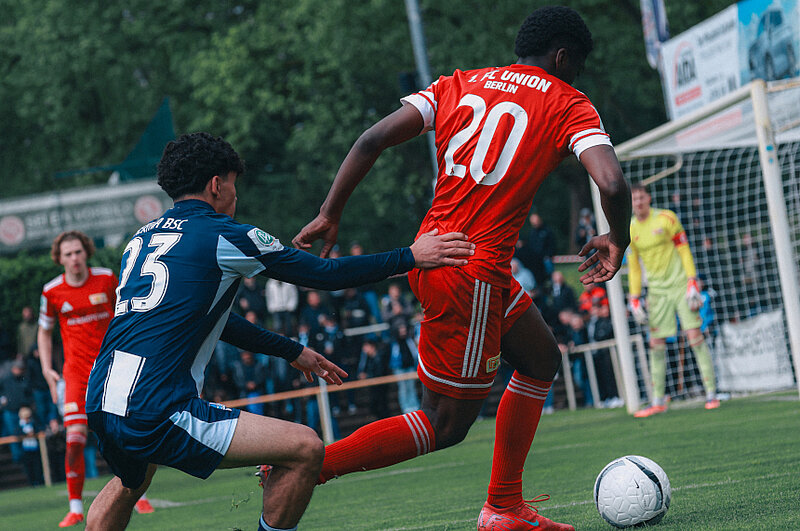

Probably everyone involved in youth soccer is familiar with this: the phenomenon of significant physical differences among individual players within a team. While some physically advanced players may be two heads taller than average, for others the jersey sometimes looks more like an oversized cape. This is because the physical development of children and adolescents is not linear, and there can be significant individual differences between biological maturity and actual age. This is referred to as the “relative age effect.”
Why can the relative age effect be problematic?
In team sports, the relative age effect is often particularly pronounced : Children and adolescents born shortly after the cutoff date for an age group (e.g., in January or February) disproportionately often have an advantage over those born shortly before the next cutoff date (e.g., in November or December). In many cases, older youth players are also biologically more mature—that is, taller, stronger, faster, and more coordinated. For younger players, this can sometimes lead to disadvantages. Scientific studies show, for example, that biologically younger children are significantly less likely to be selected for regional teams and thus receive less individualized support. The BFV’s talent development program therefore incorporates measurements of biological age into the scouting process.
A Solution Through Playing Down
To counteract the effects of the relative age effect, the German Football Association (DFB) is carrying out the “Playing Down” project in several state associations . The goal is to give biologically younger soccer players the opportunity to play in a lower age group. Starting with the 2026/2027 season, the Berlin Soccer Association will also allow U16 and U14 juniors who meet the relevant criteria to apply for a temporary reclassification to the U15 or U13 age group, respectively. This special playing eligibility must be renewed every six months and is valid until December 31 or June 30, respectively.


