


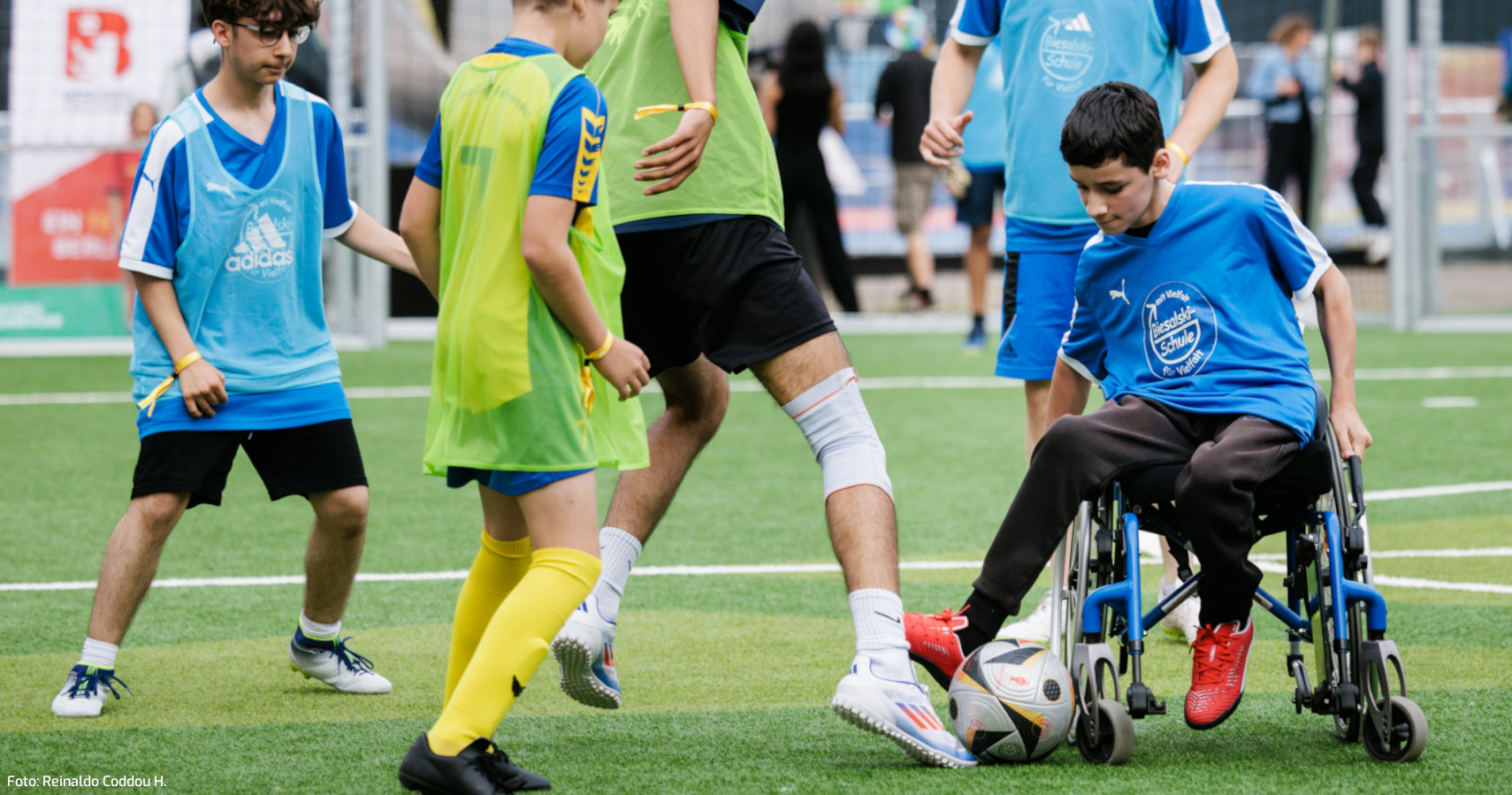

Including people with disabilities in the club - whether as players, coaches, trainers or in another role - offers a wide range of opportunities. The following hints and tips can support the implementation of an inclusive or specific soccer program for people with disabilities and, above all, show the added value of the work for clubs.
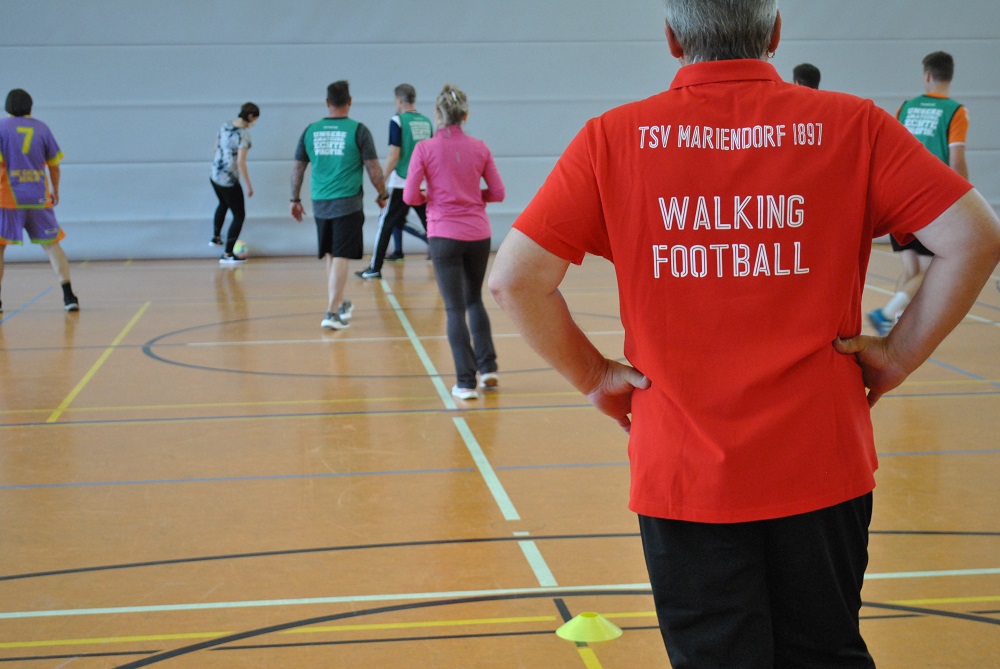
Praxiswissen
Inklusion im Fußball lässt sich nicht einfach erklären – sie muss im Alltag funktionieren. Was hilft, wenn Spieler*innen unsicher sind? Was passiert, wenn Überforderung entsteht? Und warum manche Dinge nur im Spiel selbst gelöst werden können.
Diese Inhalte richten sich an Trainer*innen, Eltern, Vereine – und an alle, die verstehen wollen, wie Inklusion im Fußball wirklich funktioniert:
Tips and advice for implementation in practice
Of course, many clubs also ask themselves various organizational questions when implementing inclusive soccer programs: What medical precautions need to be taken? What needs to be considered when it comes to insurance cover? And are there any financial support options?
These and other questions are addressed in the following sections. The contact persons of the Berlin Football Association are available to answer questions and help with the development of inclusive structures.
Downgrading to a lower age group in youth soccer
The Berlin Football Association has created the possibility of a downgrading for people with disabilities in its youth regulations (§8 division of age groups). All players with disabilities in the G- to E-youth, as well as in the D- to A-youth below the national league, can apply for a special playing right for the next lower age group. This applies to players who are classified as severely disabled (degree of disability of at least 50 percent) or who have a comparable impairment. The possibility of downgrading is also given if there is a corresponding physical or mental developmental delay. In all cases, a corresponding medical certificate must be presented. The Berlin Football Association cooperates with Charité Berlin for the examinations, which also provides appointments at very short notice if possible.
In over 85% of all cases, the right to play in the next lower division is granted after the examination. The special playing right is valid for one season, but can be applied for again for the following season, usually without further examination.
Questions about obtaining a special playing right can be sent by e-mail to Frank Schröder (Chairman of the Youth Committee: frank.schroeder@berlinerfv.de).
Insurance and pensions
Club membership
Players with disabilities are insured through club membership, as are all other players. At tournaments and other events, insurance cover must be provided in the same form by the organizer (organization, club). No additional insurance is therefore required for people with disabilities.
Duty of supervision
There are also no extended requirements with regard to the duty of supervision. The persons responsible for supervision must ensure that the persons entrusted to them for supervision do not come to any harm themselves, do not harm any other person and do not damage any property. The type and scope of supervision depends on the age, mental and character maturity and behavior of the persons to be supervised. The duty of supervision begins a reasonable time (usually 15 minutes) before the sports session and ends when the persons to be supervised leave the sports facility. Liability for breaches of the duty of supervision is regulated in §823 and §832 BGB.
Accident prevention
However, extended principles of accident prevention apply to inclusive soccer activities:
Intact and tidy changing rooms
Safe sports facilities (no tripping hazards or similar)
Intact sports equipment
Clear markings and paths
Sportswear (no jewelry, sports glasses, etc.)
The following risk factors must also be taken into account:
Emotional factors such as fear, aggression, willingness to take risks, overconfidence
Cognitive factors such as impaired sensory perception, reduced assessment of dynamics and strength, lack of risk assessment
Sensorimotor factors such as restricted movement, prostheses, balance disorders, fatigue
Medical precautions
The following medical precautions should be taken:
Obtain medical certificates (no specific requirements)
Obtain information from caregivers and parents
Provide an emergency kit
Obtain permission from supervisors to administer medication (in an emergency)
Discuss emergency scenario with team coaches, players and parents and rehearse if necessary
Protection agreement on sexual violence
People with cognitive impairments may have a different understanding of physical closeness and distance. It is important to establish rules and set boundaries in order to avoid precarious situations. There is a need for increased awareness of assaultive situations to protect both the players and the coaches.
Protection agreements clearly clarify how coaches and supervisors should behave in order to avoid precarious situations. These should be set out in writing and ideally signed by all coaches and supervisors in the club - regardless of whether an inclusive or another children's and youth team is being coached. It is also strongly recommended that an extended certificate of good conduct is inspected for this purpose.
Cooperation opportunities & funding
Opportunities for cooperation
The DFB's Gemeinsam am Ball program or the School and Sports Club program of the Landessportbund Berlin (LSB) promote cooperation between regular schools, special schools and soccer clubs. The aim of these programs is to get children and young people interested in sport and exercise, initially at a very low-threshold level and on site in the schools. The cooperations are supported in the form of honorarium money and sports materials. The prerequisites are membership of the DFB or LSB. The trainers must also have a C license and the offer must be carried out at least once a week over a period of at least one school year.
Funding
The establishment of inclusive and specific soccer programs for people with disabilities directly in soccer clubs can be funded in full or in part by various funding bodies and foundations. Aktion Mensch and the Encounter, Culture and Sport funding program are particularly worthy of mention. It supports so-called micro-projects and offers aimed at people with disabilities, children and young people or people in particular social difficulties. The maximum grant is 5,000 euros and the maximum duration is one year. No own funds are required to implement the project. Both material costs and fees are eligible for funding, but not personnel costs.
To apply: Funding from Aktion Mensch