


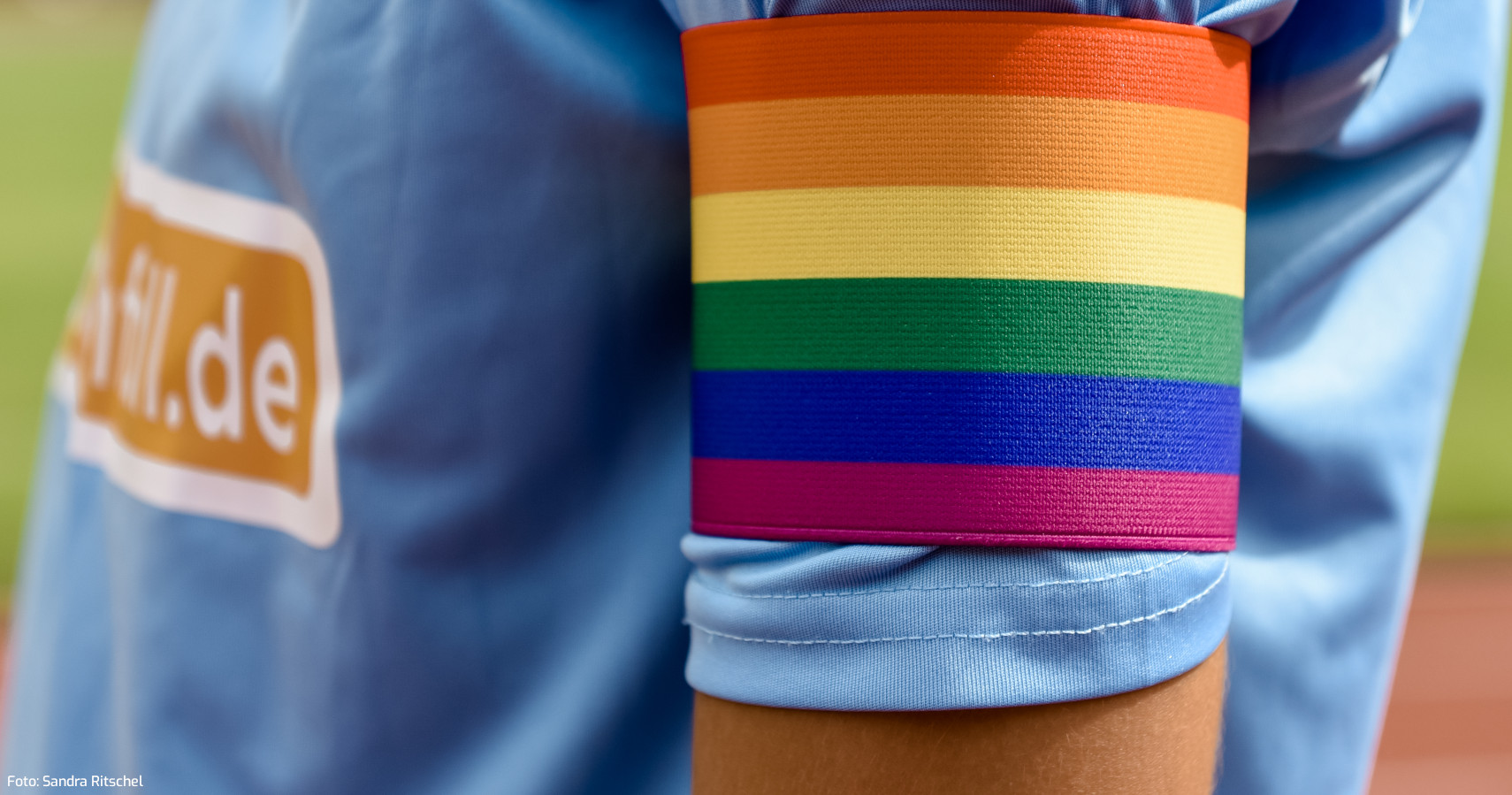

The German Football Association (DFB) has adopted a regulation on the playing rights of trans, inter and non-binary persons. The regulation came into force for the 2022/2023 season and was incorporated into the DFB Playing Regulations, the DFB Youth Regulations and the DFB Futsal Regulations for amateur soccer.
Essentially, the regulation stipulates that players with the civil status entry "diverse" or "without indication" and players who have their gender aligned can decide for themselves in future whether they should be eligible to play for a women's or men's team. This also applies to trans players, who can now switch at a time of their choosing or initially remain in the team in which they previously played. As long as the sporting activity while taking medication does not impair the health of the person concerned, they can take part in matches, which is why the new regulation rules out any relevance to doping.
LEGAL SITUATION
Since 2013, German civil status law has provided the option of choosing "no indication" for the gender entry. Since the end of 2018, people in Germany have been able to choose the option "diverse", the so-called "third option", in addition to the gender entries "male", "female" and "no indication" when making an entry in the civil status register (Act amending the information to be entered in the register of births of December 18, 2018, Federal Law Gazette | page 2635).
The decision of the Federal Constitutional Court (decision of 10.10.2017, ref.: 1 BvR 2019/16) not only affects civil status law, but also has consequences for many other areas. For example, several court decisions against Deutsche Bahn AG and RyanAir, among others, have already ruled that a service offer aimed exclusively at men and women is not sufficient and can trigger claims for damages.
Within the framework of the General Equal Treatment Act (AGG), the amendment primarily concerns protection against discrimination in working life. This results in far-reaching changes for sport, which is called upon to dismantle barriers and discrimination. It also has the task of enabling all people to participate in sport and thus also in competition. This participation must also be guaranteed for trans*, inter* and non-binary (tin*) people.
With the entry into force of the Act on Self-Determination with regard to Gender Registration (SBGG, "Self-Determination Act") on November 1, 2024, the previously applicable "Transsexuals Act" (TSG) was replaced. It enables all people living in Germany to have their gender entry adapted to their actual gender identity in an uncomplicated manner at the registry office. In media reports, the SBGG is often presented as if it were a complete novelty.
In fact, at the end of the SBGG procedure, the result is the same as under the 40-year-old TSG: a new first name and gender entry. The SBGG merely simplifies the procedure.
CHALLENGES FOR SOCCER
The DFB has been working intensively on the topic of gender diversity since 2018 and has identified various fields of action in soccer:
- The number of inquiries regarding the issuing of match authorizations in the event of a change in marital status is continuously increasing.
- DFB.NET only allows a binary, i.e. male or female, gender specification. Furthermore, the gender salutation in forms and the member registration must be adapted.
- There is a need for further training on gender diversity in clubs and associations.
- The toilet and admission situation (body searches) in the stadium were also named as critical by tin* people in exchanges of experience.
OBJECTIVE
The aim is to make it easier for gender minorities to participate in sport. This includes all people who cannot or do not want to be assigned to the binary gender system as well as people who are in a phase of physical or social transition (gender reassignment).
Central goals:
- Reduce discrimination and create an inclusive environment.
- Ensure legal certainty in order to minimize legal risks.
- Promote member recruitment and assume social responsibility.
- Taking on a pioneering role internationally and taking a stand.
Who can I contact if I have any questions?
If you have any questions, our sexual and gender diversity officers can be contacted at any time at the following e-mail address: vielfalt@berlinerfv.de.You can find an overview of our diversity team on the Contact persons subpage. We work on the collective address together.
Please note that our liaison officers work on a voluntary basis and are not available every day. However, we will do our best to respond as quickly as possible.
How does the granting of various (tin*) playing rights work?
You or your club can contact the BFV's diversity team (vielfalt@berlinerfv.de). We would like to clarify here first: Where are you at? What do you need?How can we support you? If you already have the evidence (see next question) or are already very far along in your transition, you are welcome to send the evidence directly in the email.
The diversity team will contact you and discuss the overall situation. Only the diversity team will ask for (medical or personal) evidence.
Once the situation has been clarified, the diversity team will inform the registration department about the change in eligibility. At no time do you have to introduce yourself personally to other people or explain your situation. The exchange takes place exclusively with the diversity team.
What evidence does the association need from me?
Each transition has a highly individual course.Examples of evidence of a transition are listed below. However, we would like to emphasize that you can always contact us at vielfalt@berlinerfv.de, even if you do not yet have any of the following proofs.
Adults:
dgti* supplementary identity card
Change in the civil status register
Adapted identity documents
Registry office declaration
Medical letter about transition or about taking medication to support the transition. The type and dosage are not relevant for us.
Children and adolescents:
dgti* supplementary certificate
Medical/therapeutic letter about transition
Letter from a counseling/support center in the context of transition
If already available: Change in the civil status register
If already available: Adapted identity documents
For non-German persons:
Notarized translations of the above-mentioned documents
Civil status declaration (alternative to non-amended foreign identity documents)
dgti* identity card for non-German citizens
Note: dgti* ID cards can be ordered on the website can be applied for. They act as an additional document to identity documents and are limited in time. A dgti* ID card has no effect on changes to official civil status information.
What happens to my submitted evidence?
The diversity team will look at your documents to confirm and adjust your tin* playing rights. Your documents will not be forwarded or saved. Even if you provide us with information about medication as part of your transition, only the intake, but not the type and dosage, will be recorded for data protection reasons (Art. 9 para. 1 GDPR).
Does the tin* gaming right also apply to children?
Including up to the D-Youth, children can play in mixed teams (without gender segregation). After that, children can apply for and be issued tin* playing rights. See "What proof does the association need from me?" to apply for tin* playing rights for children.
We ask parents or guardians (instead of coaches, etc.) to take over the communication with us.
Can I change my name without changing my eligibility?
Yes, you can change your name without changing your eligibility to play. All we need is the appropriate proof:
for children, e.g. dgti* supplementary ID card or proof of counseling,
for adults, e.g. dgti* supplementary certificate, adapted identification documents or a civil status declaration.
Please write to us at vielfalt@berlinerfv.de.
When does a transition begin and end?
You determine the start and end of the transition yourself, in consultation with the BFV diversity team. However, we ask you to let us know at the beginning of your transition so that we can issue you with the tin* playing rights.
Registration regulations §3, No.2: "The time of the start and end of the transition phase is determined by the person who is in the transition phase, in consultation with the responsible person of trust."
Background: Gender reassignment (transition) is a highly individual process. Transition refers to the psychological, social, medical and legal steps a person takes to adapt their physical appearance and/or their legal and social status to their perceived gender. This process (called transition) is individual and can vary greatly in duration, type, number and sequence of steps. The process is comparable to puberty, which is also individual. Some people choose medical measures (such as hormone treatments or operations), while others focus on social or legal aspects.
Both the beginning and the end of a transition can therefore not be universally defined for all trans people as being identical to one of the steps mentioned above. Many (but not all) trans people decide to change their gender entry in their civil status at an early stage because it can be a first step both for their own feelings and for the outside world. Changing the gender entry therefore often marks the beginning or start of a transition, but not necessarily a completed one. It is therefore not possible to assess the transition as completed from the outside.
Are medications taken as part of a transition relevant to doping?
No. People are dependent on medication at different stages of their lives, including during the transition phase. As long as sporting activity while taking medication does not impair the health of the person concerned, they can participate in the game. If trans people take medication due to their transition, this is medically indicated. Therefore, according to NADA, there is no doping relevance, even for listed substances.
What happens if I am discriminated against because of my gender/sexual identity?
If you experience discrimination by the opposing team or other people, please report the discrimination to the contact point.For more information on discrimination and the contact point, read here at "Frequently asked questions" continue.
In which team can a person with tin* playing rights play?
Trans: From the start of a transition, the applicant with tin* playing rights can decide for themselves whether they want to play in the men's or women's team. At the end of the transition, the right to play in the original team ends.
Non-binary, inter, agender: Persons without a male or female gender entry can freely choose which team they would like to play in with the tin* playing rights.There is no time limit for this.
How many people with tin* playing rights are allowed to play in a team?
With the change of the DFB for the 2022/2023 season, there is no longer a limit for persons with tin* playing rights. Any number of people with tin* playing rights may play in a team at the same time.
When in the season are players allowed to change their eligibility?
There are no transfer deadlines for the tin* playing right; the transfer is possible after the tin* playing right has been granted.
Registration regulations § 3, No. 2: "During this period, the person shall, upon application, be eligible to play for a team of the gender in which he/she has not previously played and in which he/she is striving to be aligned, without having to comply with waiting or transfer periods."
How often is it possible for tin players to switch between women's and men's teams?
The number of permitted changes is not yet regulated. In principle, it is possible for a person to change more than once. A person's gender identity can change over the course of their life. Especially when you consider that this regulation also applies to juniors, the possibility of changing again must remain possible.
Can players have two playing authorizations at the same time?
No, the original eligibility to play expires after one month when a new eligibility to play is issued.
Registration regulations § 3, no. 2: "The existing eligibility to play expires one month after the medical completion of the gender reassignment, unless the reassigned gender corresponds to the gender that the person has already specified."
Is it possible to select the gender "diverse" in DFBnet?
As of December 2025: No, but there is currently no option to select "diverse". DFB-IT is working on this: In 2026, the DFBnet and thus the options for specifying gender are to be revised.
Is it possible to have the player's (dead) name deleted from fussball.de?
Yes, the name can be deleted from fussball.de at the request of the person concerned. This setting can be made in DFBnet. If the "Publication" checkbox is set to "No", the name will no longer be provided to public print and online media on all past and future match reports. On fussball.de, this will make all names unrecognizable. It will then no longer be possible to re-display past match reports.
TRANS / TRANSGENDER / TRANSSEXUAL / TRANS*MAN / TRANS*WOMAN (OBSOLETE: TRANSSEXUAL)
Trans* is the term used to describe people who do not identify with the gender assigned to them at birth. Trans* is a collective term for all self-designations, with the * serving as a placeholder for all other designations after the "trans". The spelling trans* is used adjectivally and is therefore written in lower case and as a single word in conjunction with trans* man or trans* woman. Not all people who see themselves as trans* undergo gender reassignment surgery.
INTER / INTERSEXUAL / (OBSOLETE:INTERSEXUAL*)
As a rule, newborns are assigned a gender based on their apparent genitalia. It is not always possible to determine the sex, and in some cases it can be determined later in life that the assignment at birth was incorrect. Characteristics can develop that can be assigned to both the male and female sex. In medical terms, this is referred to as "variants of gender development". The people concerned are referred to as inter*.
DIVERS
Diverse is one of four possible legal gender entries in Germany. It is often referred to as the "third option" because it is the third positive civil status introduced by the federal government at the end of 2018. Until then, there were only two positive (male/female) and one negative ("no entry") legal civil status. A change of civil status is possible via the Self-Determination Act with regard to gender entry (SBGG).
NON-BINARY GENDER IDENTITY
Non-binary gender identity describes the identity of people who do not identify exclusively as either male or female. They see themselves as being outside the traditional, binary gender order. Non-binary people can experience themselves as a mixture of both genders, as neither, or as something completely different. Terms such as genderqueer, agender (genderless), genderfluid (fluid gender identity) and bi-gender (two genders) are examples of non-binary identities. Gender identity is based on a person's inner feelings and not on biological characteristics.
TRANSITION
Transition or gender reassignment is the process of adapting one's own experience to one's gender identity. Transition varies from person to person and can take several years. A transition may involve taking medication and/or undergoing gender reassignment surgery - but it does not have to. First names and gender entry can be adjusted during a transition, but they do not have to be.